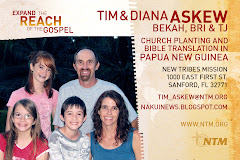
Want to know why pioneer church planting in many tribal contexts takes so long? Despite our most well planned and valiant efforts, it seems like something ALWAYS comes up which hamper the expected results. This disappointing report doesn’t deal directly with Nakui church, but the ripple affect touches everyone in the Nakui tribe.
In an earlier posting I described how the VHV medical program holds out hope for the Nakui and many surrounding Sepik tribes to receive basic medical training as well as the necessary credentials to receive ongoing government subsidized medicine. What a deal, right? Finally gaining access to government services - always far beyond Nakui reach until this point - is about the biggest civic development for this society since, well … the discovery of saksak. Or at least that’s the way I, for one, think about it.
After successfully completing the six-week classroom coursework last fall (we paid to fly in and house the training personnel to put the course on at Iteri), all that remained was the practical training for our two students. Problem: the course can only be offered at a medical post about 30 miles and 3-days hike away in a neighboring tribe. Solution: the students hike together with other neighboring students to this location, arriving a day or two before the course begins. They all agreed this was doable (3-day hikes aren’t uncommon) and committed to being there.
What could possibly get in the way now? Finally … the down-and-out Nakui were poised and on the brink of taking a HUGE leap ahead! Their diplomas awaited them. They only need to show up and complete this short, two-week module. But it never happened. Dominik, the medical trainer, graduated students from a number of surrounding tribes, but there were no Nakui certificates handed out.
What happened? A brother of one of the Nakui students had stolen a shotgun from someone who lives in the area where the course was taking place. Fearful of what payback may come upon them, the day of departure they decided not to join the delegation of students. It was the resulting fear of this one man’s actions that held them back.
This is an ongoing theme in these remote tribes; the actions of one holding back the many. Over and over we’ve seen men, in a fit of rage, destroy community water tanks, medical clinic bug screen, and even a community outboard motor. What we work for years to establish can be reversed faster than a jungle sunset. It’s hard to say where we go from here. First we need to get back to Nakui and hear them out and see if there is a desire to fix this. There might be something we can all do about it, but next time it will probably cost them a whole lot more than just a 3-day hike. How bad will they want it?
Tuesday, May 12, 2009
Wednesday, February 4, 2009
Five Primary Obstacles in Communicating Christ
I know ... it has been a LONG time since I've posted anything on the blog. A number of you have been asking about this, and I have no excuse except to say that it's been CRAZY since Thanksgiving. Now that a few of my other responsibilites have eased up, I plan to get back to blogging.
I spoke to a group of high schooler this past weekend at Maranatha Chapel, and we spent some time talking about barriers to the Gospel in tribal church planting. Together we identifed the barriers we would anticipate in taking the Gospel to a typical unreached group of people (we used a tribal group in PNG currently asking for missionaries as our example).
Here are the five barriers we determined we would face which would need overcoming in order to fulfill our goal:
1) Geographic -- It takes a team to do this task. We will most likely need to link up with other who we share a common vision or partner with an organization which specializes in mobilizing people to remote locations.
2) Relationship -- You don't get anywhere in missions without genuine relationships. Through relationships we gain credibility to minister and speak into lives. Our model is Jesus, who lived openly and genuinely among those he served.
3) Linguistic -- These groups are unreached because they cannot speak the major languages of the world or the national languages of the country. If we determine the heart language of these people is the vernacular, we must commit to learning this language and doing Bible teaching and translation. This is the only way to give them full access and understanding to God's Word.
4) Culture -- We must understand who they are as a people before we can hope to meet their spiritual need in a profound way. In order for them to engage God's Word, it must be interesting and relavant to their lives. In the case of the Nakui and most animists, they learn better by hearing narratives than by systematized approaches.
5) Worldview -- Everything we teach must speak into or challenge their current worldview. The key themes of the Christian worldview (God is creator, is loving, is omnipotent, is our authority, punishes sin, is gracious, etc...) must be woven into narrative stories and then taught through and explained clearly.
While this is not an exhaustive list, I thought the group did a pretty good job of highlighting most of the challenges we must anticpate in a pioneer missions context. These are certainly among the primary barriers we faced (and continue to do so) in the Nakui context. If you would like to read my lecture notes click on
http://docs.google.com/Doc?docid=dhp2jgdq_3dkcb8zdm&hl=en.


Saturday, November 15, 2008
Training Medical Workers in Remote Tribal Areas
Malaria runs rampant, indiscriminately takes its toll on young and old alike. Painful boils incapacitate even the strongest men. Chest infections due to almost constant smoke inhalation are common. Neonatal care is almost non-existent. Run-away ear infections cause permanent hearing loss. Traditional first-aid treatments are more counter-productive than just doing nothing. Poor hygiene habits breed germs and disease. These are some of the realities in the Nakui world when it comes to health care.
Beginning in the 1980’s, NTM brought major improvement in medical treatment and training to the Nakui area. An aid post was first established in Iteri, and later in Nakui where indigenous volunteers were trained in first-aid and basic medicine. The result is that infant mortality has been cut from 50% to below 5%, and fatalities from malaria is now exception and not the rule. People in all directions cross mountains and wade through jungle swamps to receive treatment from these trained volunteers. Populations are growing, and the sound of groups of children playing can once again be heard in these villages.
But the question always remained … what happens to these medical programs after NTM moves out of these areas? With no official certification, how will these remote villages gain access to medicine and supplies? Who will help train the next generation of medical volunteers? There have always been more questions than answers. Until now.
This past year, in cooperation with the Sepik provincial health department, NTM began organizing and sponsoring a 6-week village health volunteer (VHV) training program. Upon graduation medical volunteers in these remote villages are certified to receive medicine and supplies from the government and to perform basic medical and neonatal treatment. Presently a VHV course is in full-swing at the Iteri airstrip, with approximately ten medical workers in training, including two Nakui men (Auiyo and Kibo). Though this may seem like a small development, this is the very first time these tribes have received ANY kind of medical education or training from the government. More importantly, this program puts these remote people groups on the health department’s radar, and means access to free medicine (although the airplane freight cost sure isn’t free!) and ongoing government-sponsored training. Windows of hope like this are rare for the Nakuis … I hope and pray both they will take full advantage of it.
Saturday, October 4, 2008
Challenging days for the Nakui church
We heard from Greg and Heidi Greenlaw last week, who recently moved back into the tribe after covering leadership needs at the Wewak base for 6 months. The news out of Nakui is not overly encouraging. For the G-laws personally, they returned to find a good number of their solar panels had blown off the house and their power system down. This, in turn, shut off the 12-volt fridge which meant a freezer full of rotten meat greeted them upon arrival. Most of the next week was consumed with repairs and maintenance in order to get their home livable again. We've done that one before and let me tell you, it's not very fun.
One of the keen Nakui believers who has showed promise as a Bible teacher is struggling. This man has been a key figure in the church and was very intstrumental in the outreach to Yabu village last year. After many months of accusations, it has finally come to light that he has been in an adulturous relationship with another woman. To make matters more complicated this woman, who is another believer, is his wife's very good friend. There is now pressure on this man (from her family) to take this woman as his second wife (polygamy is not only common but a sign of status in Nakui culture). This man's wife is beside herself and making life miserable for everyone around her. What a mess. When God's people live according to the world's ways and not surrendered to the Lord, there is always a cost. In this case the Nakui church is paying a heavy price.
Another struggle in the church has to do with the death of Tunawe's daughter Sien. Although Diana spent much time in June nursing her back to health, she died in July of a mystery illness. I'm sure Tunawe, who had just recently lost his father Imo, was devistated. Nakui animistic beliefs require someone or something be blamed for death, and this time the blame was cast toward Yabu - the very village the Nakui church did their outreach. Relationships with Yabu had already been strained. Now they teeter on the brink of war. A few days badk a band of Nakui men left to attack Yabu, but were talked out of it by a man who lives in a village half-way village. During a church meeting the following day it sounds like Greg was able to initiate some healthy discussion centered around 1 Thessalonians 2 where Paul describes being holy, rightous and blameless among they young Thess. believers. This is indeed a key time in the life of TWO churches in the Nakui language group -- they need our prayers.
Thursday, October 2, 2008
Wednesday, September 24, 2008
Wednesday, September 3, 2008
Fear
I read in this morning's paper about the smell of fear. It turns out scientific researchers report labratory mice were able to detect with their noses the "alarm pheromones" emitted into the air by other mice that were subjected to stress. It also turns out that we humans have the same nerve mechanism at the tip of our noses. Although I've been told my sense of smell isn't overwhelming, next time I find myself in a room of nervous tension, I'm going to take a deep wiff and give see what fear actually smell like. :-)
Not that fear and anxiety are laughing matters. I recently read where nearly a quarter of the adult population in the US will have an anxiety disorder sometime in their lives. That's a lot of stressed out people. Fear certainly isn't unique to our corner of creation. In the Nakui world it's an overwhelming theme in the lives of men, women and children. Fear of the unseen world ... fear that even a close friend from outside the village could be a sorcerer sent to attack ... fear that an unsuspecting illness could take the life of a loved one ... fear of a recently diceased relative roaming the village at night looking to take someone with him. It's no wonder that when Nakui believers meet, it's not long before the subject of heaven comes up. There is a genuine longing for what God has prepared for us once we trade in these imperfect bodies living in this fallen world. In their prayers, as well, it's a major theme. Below I pasted a recent prayer by Tuti, one of the Nakui believers and up and coming leaders, before sharing the Lord's Supper.
"Thank you Papa, you are always helping us. You have given us your Word, it’s no small thing. It is the talk that opens up Heaven’s road to us. Our ancestors did bad actions, they went to the place of fire. We are glad we will go see you in heaven. Your talk of getting us back from the fire is good. Jesus didn’t come to this ground for nothing; he came to help us by throwing away our sins. He came and did this work, then he went back to heaven again. When he knew he was about to die, he called his followers together and he ate with them. He said the wine water was like his blood and the bread was like his body. He told them to eat like this over and over again so they would remember him. Oh God, this is very good. When we do this in Jesus’ memory it is good. Thank you to you, God, for sending Jesus to us. His blood spilled on the ground, his body got broken. He did this for so we can live forever and ever with him in heaven. We say thank you to Jesus."
Subscribe to:
Posts (Atom)